
Nethues Technologies Private Ltd

Automation Tool for Managing Pathology Workflow

 Client Image

About the Client

The client operates a diagnostic pathology network with multiple lab sites across Australia, handling a high volume of specimens each week across histopathology, cytology, and general testing. They work closely with referring GPs, specialists, and hospital networks nationally.

Their broader vision was about modernising how pathology labs manage specimen flow, case assignment, and reporting, without losing the accuracy and compliance rigour the sector demands. They wanted a platform built specifically around how pathology labs actually operate, not a generic workflow tool retrofitted for healthcare.

The company was highly focused on turnaround time and getting the right case in front of the right pathologist. That focus shaped everything about how the project was scoped.
 

Project Requirements image

Project Requirements

The client came to us running on a mix of legacy LIS modules, spreadsheets, and manual handoffs between lab techs and pathologists. It worked, but barely, and it wasn’t scaling well across sites.

The core issues were operational, not just technical. Case turnaround was slipping on complex specimens. Pathologists were picking up cases outside their subspecialty simply because there was no logic in place to route work intelligently. And lab managers had no real-time way to see where a specimen sat in the pipeline, so basic questions like “where’s this case right now” required phone calls or someone walking the floor.

There was also a compliance layer that couldn’t be skipped. Operating within Australia’s pathology accreditation framework meant audit trails and access controls needed to be built in from day one, not added later.

Overall, the client was looking for the following:

  • Specimen tracking from intake through to pathologist sign-off
  • A workload-balancing mechanism so pathologists received a fair, consistent volume of cases
  • Subspecialty-aware case routing based on pathologist preferences and expertise
  • A real-time dashboard for lab managers to monitor backlog and case status across sites
  • Audit-ready chain-of-custody logging for accreditation purposes
  • A rollout that wouldn’t force labs to stop processing specimens mid-transition
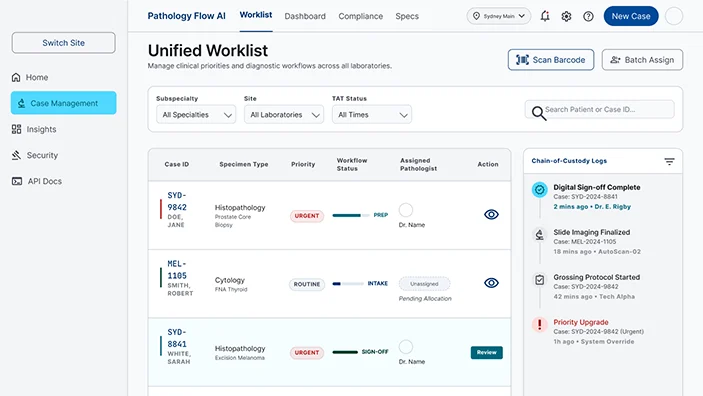
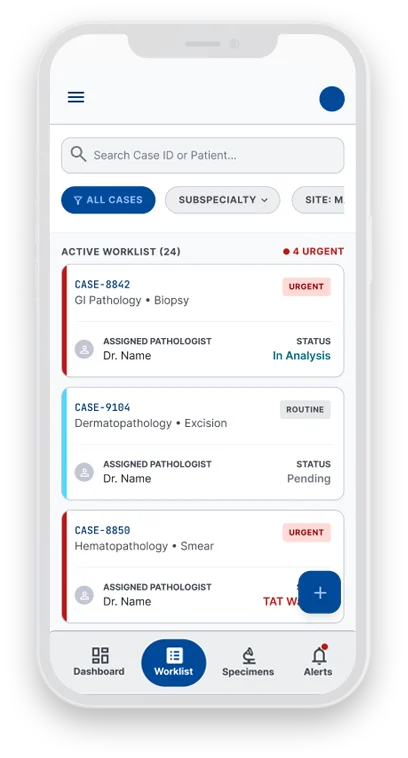
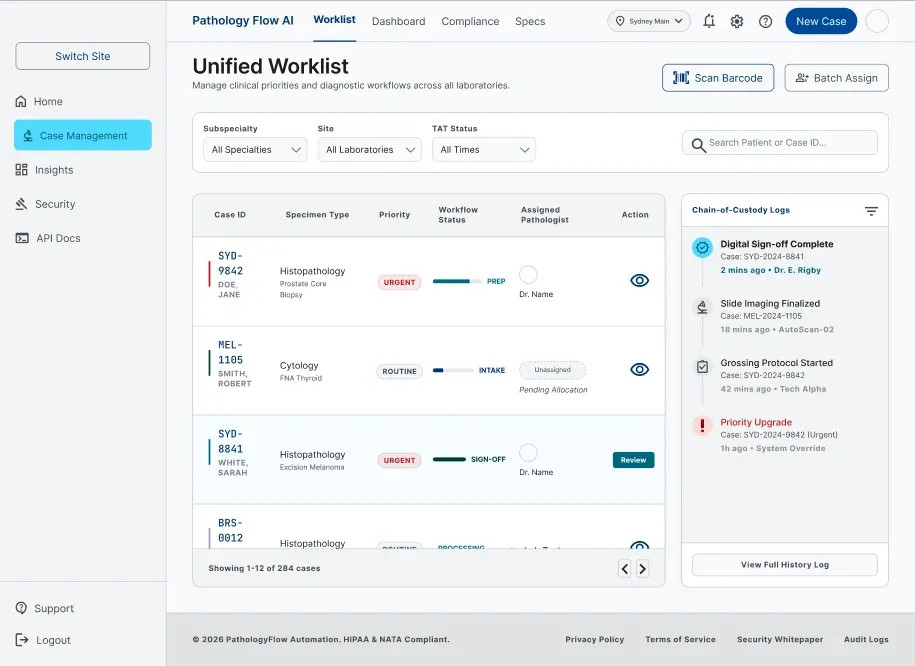
  • A single, unified worklist pulling together data from LIS, barcode scanning, and specimen-tracking hardware
Web image
Our Solution image

Our Solution

We built a workflow layer that sits on top of the client’s existing LIS. We didn’t replace it. Pulling out a live LIS mid-operation is too risky for a pathology lab.
At the centre is a rules-based routing engine. It looks at subspecialty, pathologist workload, and case priority. Urgent cases move to the front automatically. We also added a load-balancing feature. It spreads cases evenly across pathologists. This helped turnaround time and cut down errors.

We unified data that used to sit in separate systems. Specimen details, barcode scans, and LIS records now live in one worklist. Lab staff stopped switching between screens just to check a case’s status. This became one of the most-used features.

We also built a chain-of-custody log. It tracks every handoff, from specimen receipt through prep, processing, and sign-off. This covers the audit trail for accreditation. Lab managers use it to spot bottlenecks, too.

Rollout was staged site by site. Each location ran the new system alongside the old one first. This gave staff time to catch issues before the full switchover.

client rating icon

Client Rating

Nethues Technologies

Excellent

Client's name and profile image can not be disclosed due to the NDA (Non Disclosure Agreement)

Technology image

Technical Bits

  • React & TypeScript Frontend
  • Node.js Backend APIs
  • PostgreSQL Database
  • HL7 Interface Engine for LIS Integration
  • Barcode & Specimen-Tracking Hardware Integration
  • Role-Based Access Control (RBAC) Architecture
  • Docker & CI/CD Infrastructure
  • Multi-Site Deployment Architecture

Want to see our project from inside-out?

Visit Now