Most businesses looking into AI hit the same question early on. Do you use tools that already exist, or build something new from scratch? People mix these two up all the time, and that mix-up wastes real time and money. Before you hire an AI development company, it helps to know exactly what you’re paying for, because integration and development solve different problems, and they cost very differently too.
Quick answer: AI integration means connecting pre-built AI tools (chatbots, automation platforms, AI add-ons) into your existing systems. AI development means building a custom model trained on your own data to solve a problem no off-the-shelf tool can handle. Integration is faster and cheaper. Development is slower, costlier, and yours to own.
What’s the Real Difference Between AI Integration and AI Development?
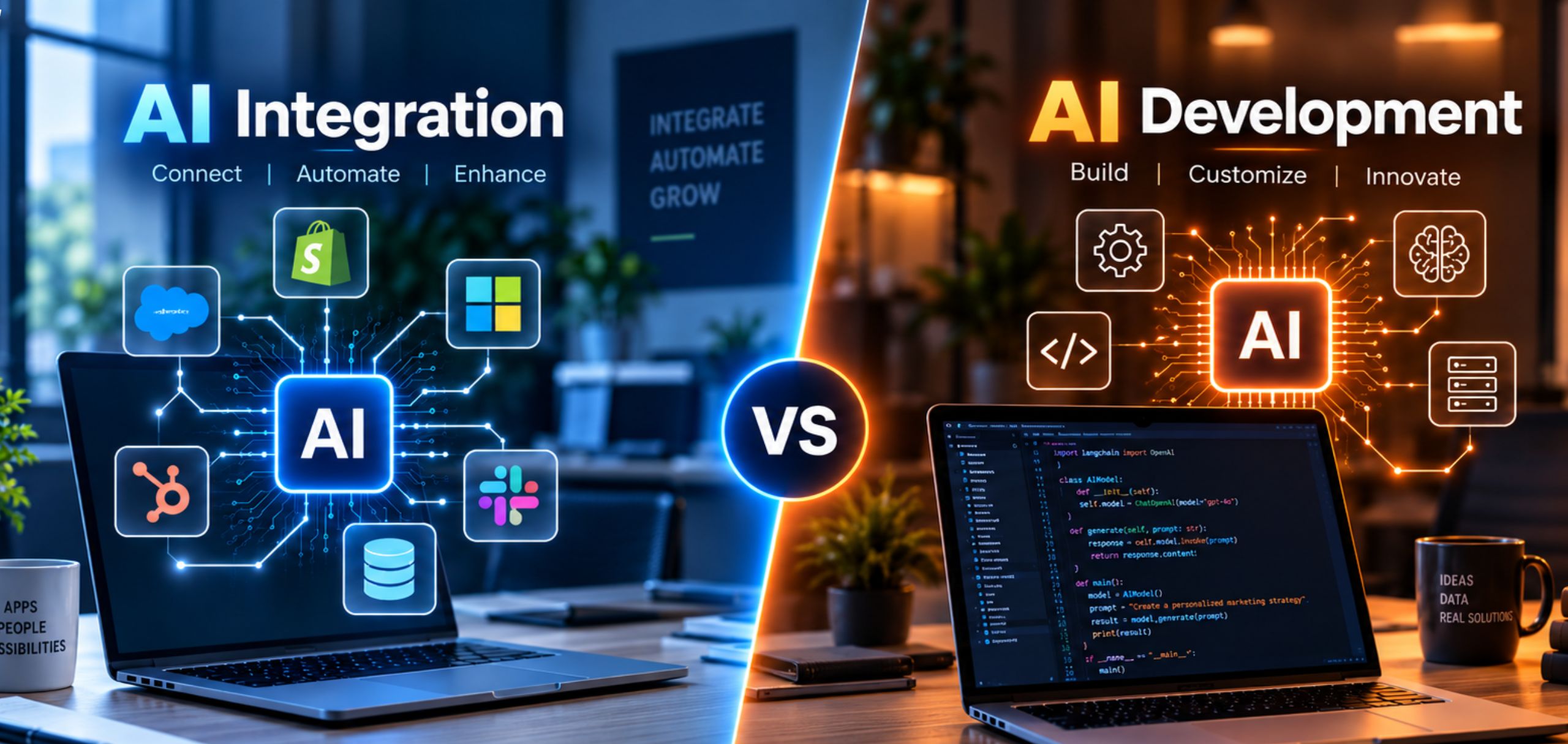
Integration is assembly. Development is construction. When you integrate, you’re wiring existing AI capabilities- think a chatbot platform or an AI-powered CRM add-on- into workflows you already run. Nobody’s training a model from scratch. When you develop, a team builds something new around your data, your edge cases, your compliance rules. It takes longer, and it isn’t cheap, but you end up owning something a competitor can’t just subscribe to.
| Factor | AI Integration | AI Development |
|---|---|---|
| Timeline | Weeks | Months to a year+ |
| Upfront cost | Lower | Higher |
| Customization | Limited to the tool’s flexibility | Built around your exact workflow |
| Data ownership | Often shared with the vendor | Fully yours |
| Best fit | Common, well-defined problems | Unique or regulated use cases |
When Does AI Integration Make Sense for a Business?
If you need something working this quarter, integration is almost always the answer. A B2B support team adding an AI chatbot to handle recurring client queries doesn’t need a custom model; it needs a tool that plugs into the helpdesk it already runs. Early-stage B2B companies lean on integration for the same reason: it lets them test whether AI actually moves the needle for their sales or support process before committing serious budget.
B2B teams use this path constantly. Lead-qualification bots feeding a CRM, automated invoice reminders, AI-assisted email triage for sales and account teams- none of it requires a development team. A business evaluating AI chatbot development services for something this standard is usually better served by an existing platform than a ground-up build, at least to start.
When Should You Invest in Custom AI Development Instead?
Custom development earns its cost when the problem is genuinely yours. A logistics company optimizing delivery routes across a fleet with irregular constraints won’t find a generic tool that fits. Neither will a healthcare provider that needs a model trained on its own clinical data under strict compliance rules, or a bank building fraud detection tuned to its actual transaction patterns.
Regulated industries push toward custom builds more often than not. Off-the-shelf tools are built for the average case, and compliance rarely tolerates “average.” If your workflow is the differentiator, not just a nice-to-have, development is where the value actually sits.
How Much Do AI Integration and AI Development Cost?
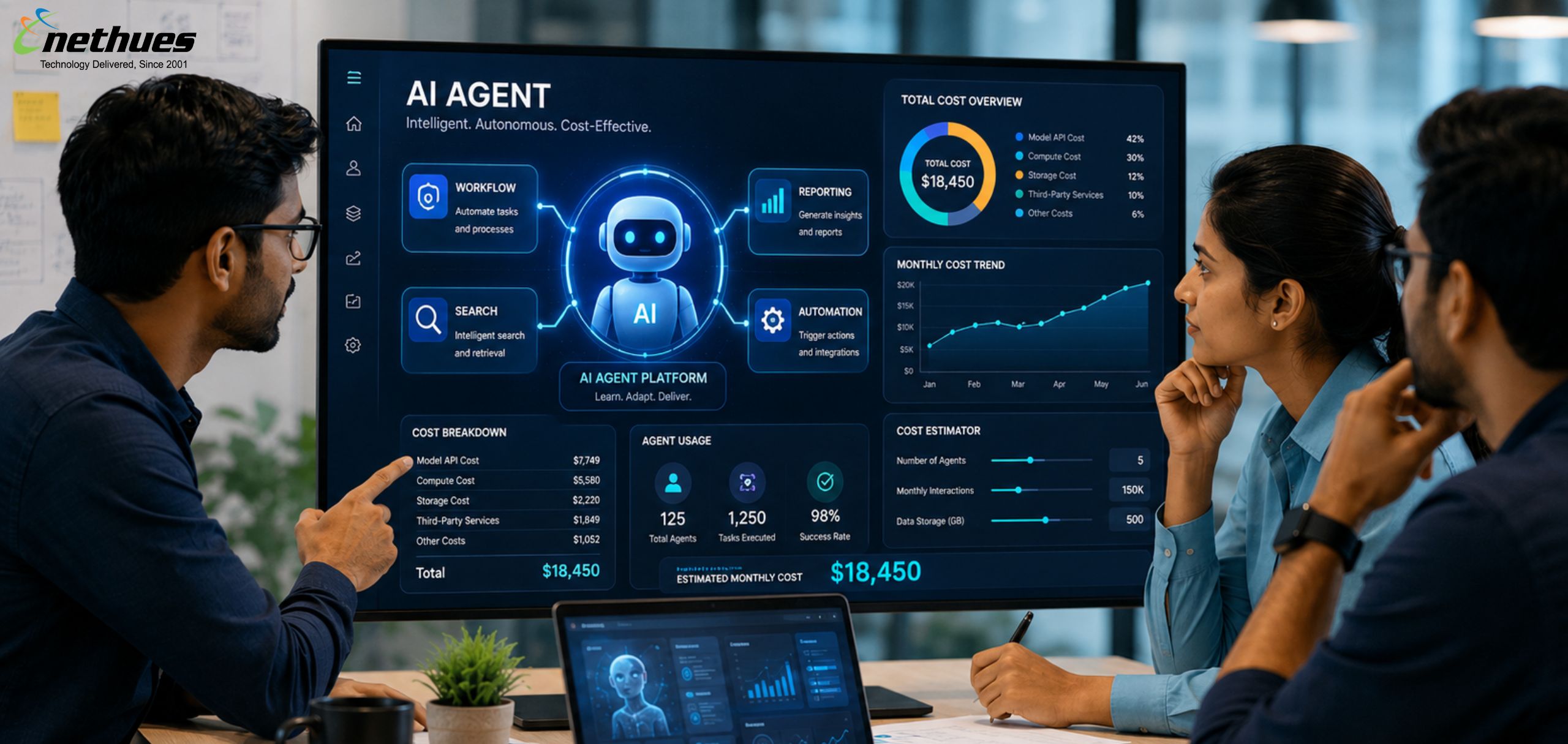
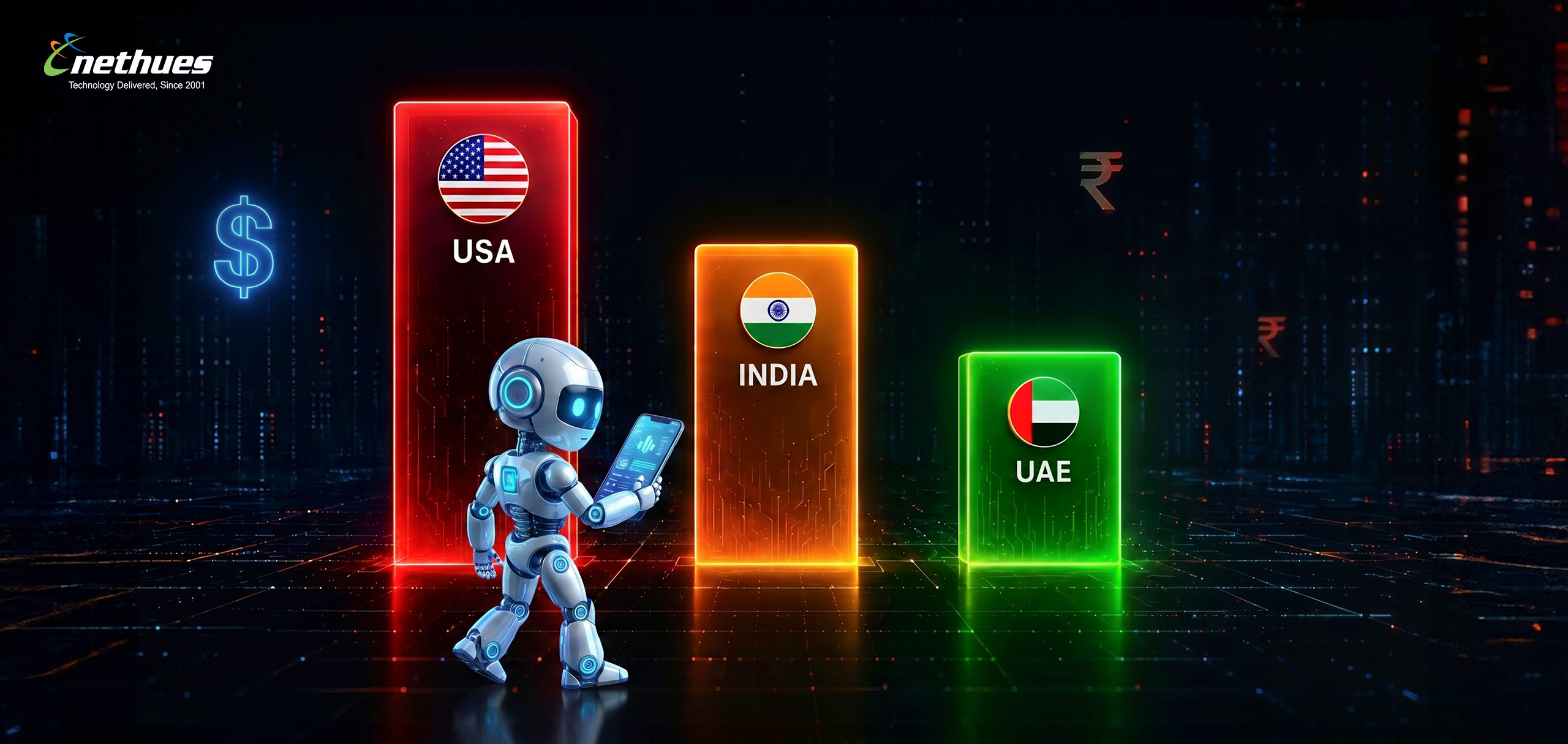
AI integration usually runs on subscription pricing, typically $50–$500 per month for small to mid-sized stacks, depending on how many tools you layer together. Entry-level AI assistant seats can start as low as ~$5–$30/user/month, but usage-based APIs and multi-tool setups often push total monthly spend higher.
Custom AI development is a different category. A tailored build commonly ranges from $20,000 to over $200,000, driven by data complexity, model scope, and how much post-launch tuning and MLOps support you need. Larger, enterprise-grade multi-agent platforms or custom-trained models can exceed $250,000–$500,000+.
That gap is widening, not narrowing. Gartner projects that 40% of enterprise applications will feature task-specific AI agents by the end of 2026, up from under 5% in 2025, a jump that’s already pushing more companies to treat custom builds as near-term priorities instead of “someday” projects.
Budget for both the build and the ongoing run cost: hosting, monitoring, and retraining don’t stop once the project ships. Industry benchmarks typically model 10–25% of build cost per year for retraining and maintenance, plus separate infrastructure and governance budgets.
What Risks Come With Each Approach?
Integration’s biggest risk is dependency:
- The vendor changes pricing, gets acquired, or shuts the tool down, and your workflow breaks with it
- Your data often lives on someone else’s servers the whole time, not yours
- Even something as routine as a chatbot deployment means trusting another company’s roadmap as much as your own
Development carries a different kind of risk:
- Projects run late and scope creeps as requirements shift mid-build
- A model that performs beautifully in a demo can fall apart the moment it touches production data, usually a sign the integration work was rushed, not that the model itself was bad
- Data pipelines break moving from testing to live traffic more often than teams expect
- Ownership across engineering, product, and data teams tends to stay murky until something goes wrong
Neither path is risk-free; the honest move is picking the risk you’re better equipped to manage, then planning around it instead of hoping it doesn’t happen.
Can You Combine AI Integration and AI Development?
Yes, and most businesses that get real value from AI end up doing exactly this. Start with integration to validate that a use case is worth solving. Once you understand where the generic tool falls short, invest in a custom build for that specific gap. It’s a cheaper way to learn what you actually need before spending big on something permanent.
Think of it as a sequence rather than a choice. A B2B software vendor might integrate a support chatbot first and watch first-response times drop within weeks. If enterprise clients then start asking for account-specific reporting or workflow logic the chatbot can’t handle, that’s the signal to move toward a custom model, not before. Businesses that skip straight to development without testing the simpler option first often end up building something more complex than the problem actually required.
How Do You Decide Which Approach Fits Your Business?
A few questions tend to settle it fast:
- Do you need results inside a month, or can the project run longer?
- Is this problem common across your industry, or is it genuinely unique to how you operate?
- Can your team live with ongoing subscription costs, or do you need full ownership?
- Do you have in-house technical staff, or will you need an outside partner either way?
- Will this need to scale significantly as your business grows?
Most businesses land clearly on one side once they’ve answered these honestly; the ambiguity usually comes from skipping the questions, not from the answers being close.
Final Thoughts
There’s no universal right answer between integration and development, only the right answer for where your business stands today. Small teams chasing fast wins usually lean toward integration. Companies with a genuinely unique problem, or one tied to compliance, tend to get more from a custom build. What matters is matching the approach to your actual constraints, not to whichever option sounds more impressive in a pitch deck.
If you’re still weighing the two, talk to a team that’s done both. Nethues has spent 24+ years building custom software and AI systems for businesses across industries; we can help you figure out which path actually fits before you spend a rupee on either one, as an AI development company that’s seen what happens when teams pick wrong.
Frequently Asked Questions
Is AI integration cheaper than AI development?
In almost every case, yes, at least upfront. Integration runs on subscription pricing in the low hundreds per month, while development costs scale into tens or hundreds of thousands depending on complexity. The catch is long-term cost: a subscription you’re still paying for in three years can end up costing more than a custom build would have.
Can a small business afford custom AI development?
Sometimes, but it’s the exception rather than the rule. Most small businesses get more value from integration first, then move to a custom build once a specific, high-value problem justifies the spend. Jumping straight to development without validating the use case is one of the more common ways smaller teams burn budget.
How long does AI integration typically take?
Pilot single-workflow AI integration usually requires 2-6 weeks, multi-system automations 6-14 weeks, and enterprise-wide custom AI transformations 6-18 months, depending on data readiness, legacy systems, and security/compliance requirements.
Do AI chatbot development services always require custom development?
No, the majority of chatbot deployments are integration work, not development. Businesses only need a custom-built conversational AI when their use case involves proprietary data, multi-step logic, or compliance requirements that off-the-shelf chatbot platforms cannot address.