Most businesses already understand generative AI. It writes content, helps with coding, and speeds up everyday work. But there’s still a gap between creating something and actually getting the work done.
That’s where the conversation around Agentic AI vs. generative AI becomes important.
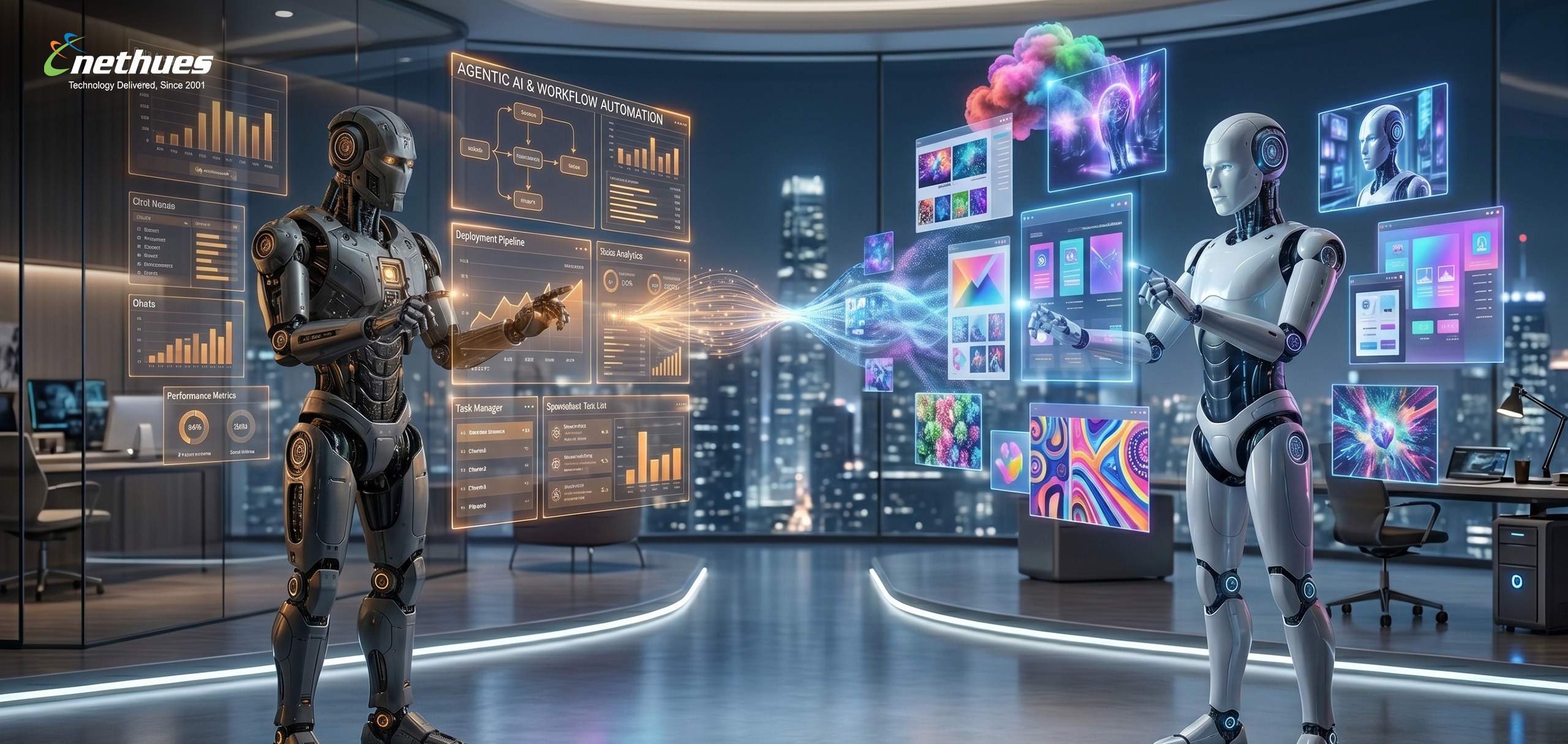
In simple terms, generative AI produces outputs. Agentic AI takes those outputs and moves work forward. One supports decisions. The other acts on them. That shift may seem small, but it changes how systems are designed and how work flows inside a business.
Early studies show AI-driven automation can reduce manual workload by 30–40% in multi-step business processes (McKinsey insights).
What is Agentic AI?
To understand what is agentic AI, think of it as a system that doesn’t stop at a response.
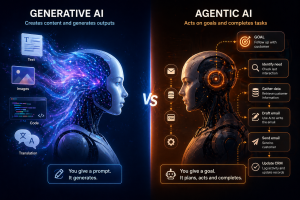
Instead of waiting for repeated instructions, it works toward a defined goal. It can break that goal into smaller steps. Further, it uses available tools and executes tasks with limited input. Over time, it can also adjust based on what’s happening around it.
This is why agentic AI is often described as goal-driven. It behaves more like a layer that sits across systems for coordinating actions.
In practical terms, it reduces the need for constant back-and-forth. Once the direction is set, the system continues the work. By 2028, 33% of enterprise software applications will include agentic AI (Gartner).
What is Generative AI?
Generative AI works differently. It is built to create. It responds to prompts and produces outputs like text, images, or code. It can adapt tone, structure, and style based on context. This makes Gen AI useful across a wide range of tasks.
But its role ends at creation. After generating a response, it relies on the user to decide what to do next. This is why most workflows using generative AI still involve manual steps. The tool assists, but it does not carry the task forward.
Agentic AI vs. Generative AI – Quick Comparison
| Feature | Generative AI | Agentic AI |
| Role | Creates content | Executes tasks |
| Behavior | Reactive | Proactive |
| Task Type | One step | Multi-step |
| Output | Text, images, code | Actions and outcomes |
| Human Role | Drives next step | Oversees process |
Agentic AI vs. Gen AI: What Actually Changes?
The agentic AI vs. gen AI comparison becomes clearer when you look at how work moves. Generative AI is designed for moments. You ask, it responds, and the interaction resets. It works well when tasks are isolated and clearly defined.
Agentic AI is designed for continuity. It carries context forward. It evaluates what needs to happen next and continues operating until the goal is complete. That ability to maintain direction makes it useful in real workflows. This is also why discussions around how to build an AI model are shifting from just training models to designing systems that can plan, act, and adapt over time.
Another key difference is how decisions are handled. With generative AI, decisions still sit with people. With agentic AI, some of those decisions are built into the system, within defined boundaries. That reduces delays, especially in processes that involve multiple steps or handoffs.
Agentic AI vs Generative AI Examples
A few simple agentic AI vs generative AI examples show how this plays out in real situations.
1. Sales Follow-Up
A generative AI tool can draft a follow-up email in seconds. That saves time. However, the rest of the process still depends on someone taking action.
An agentic system handles the full sequence. It can:
- Track when a follow-up is needed
- Gather customer details
- Generate the email
- Send the email
- Update records.
So, agentic AI can transform a set of disconnected steps into a single flow.
2. Research and Monitoring
Generative AI can summarize an article when asked. It works well for one-off queries.
Agentic AI takes a longer view. It can monitor multiple sources. It also filters relevant updates and notifies you when something important changes. Instead of reacting to requests, it keeps the process running in the background.
3. Scheduling and Coordination
With generative AI, you might ask for a meeting invite draft. It gives you the content, but you still manage the logistics.
An agentic system handles coordination. It checks availability and sends invites. It also tracks responses and adjusts when schedules change. The difference is not in capability, but in how much of the task is actually completed.
4. Software Issue Handling
Generative AI can explain an error or suggest a fix. That helps with understanding the problem.
Agentic AI can go further. It can run diagnostics, test possible solutions, apply the fix, and monitor results. This reduces the time between identifying an issue and resolving it.
Conclusion
The real impact of Agentic AI vs. generative AI is not technical. It’s operational.
In many businesses, work slows down between steps. Someone has to decide what happens next, pass it on, or follow up. These small delays add up.
Agentic AI reduces that gap by keeping work moving. It connects actions, decisions, and systems in a way that removes friction.